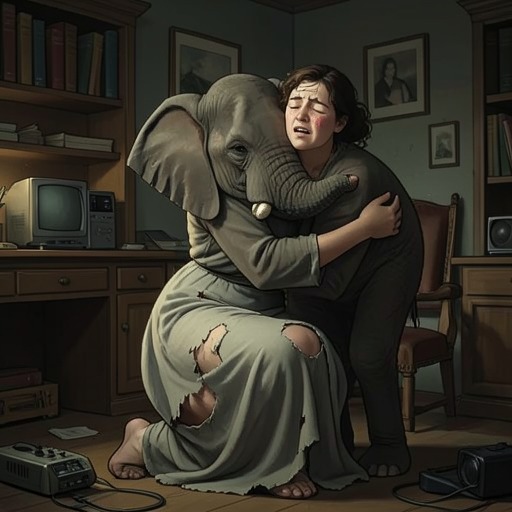
Mrs. LaVaughn withdraws her accusation against the magician
The Magician's ElephantBettine LaVaughn’s withdrawal of her accusation changes the magician’s fate at the moment Leo Matienne is prepared to return him to prison. After the elephant’s appearance has destroyed the opera-house roof and crippled Bettine LaVaughn, she had supported the magician’s prosecution; now, with the magician before her, she says the punishment would be pointless, releases him, and promises not to press charges. The decision turns a legal demand for retribution into a personal act of release, without erasing either the injury or the strange chain of events that produced it.
The legal question behind the accusation
The dispute begins with an event the police have no established procedure for handling. The chief of police believes firmly in the letter of the law, but repeated consultations of the handbook yield no guidance for a beast that has appeared out of nowhere, demolished an opera-house roof, and crippled a noblewoman. With no rule to apply, he asks his subordinates what should be done with the elephant. One proposes waiting to see whether she disappears; another insists that she is a criminal and should be tried and punished as one.
Leo Matienne challenges that proposed classification rather than simply offering a different penalty. He asks why the elephant should count as a criminal and compares her to a rock thrown through a window: the object that causes damage is not necessarily the morally responsible agent. He then stresses that the elephant did not choose to crash through the roof and asks how she could be guilty of something she did not wish to do. The exchange separates causal involvement from culpability, but it also exposes the limits of the law as the police understand it: the handbook offers no answer, and the elephant has no voice in the officers’ deliberation.
Bettine LaVaughn’s later choice concerns the magician’s prosecution, not a resolution of that earlier question about the elephant’s responsibility. The distinction matters. The magician remains the person whose punishment can be pursued through the police, while the elephant’s appearance and the damage it caused have already been treated as grounds for deciding what should happen to her.
From public custody to private possession
The Countess Quintet’s intervention makes the elephant’s legal and material vulnerability concrete. Because the countess’s home has no door large enough for her, a dozen craftsmen work around the clock to knock down a wall and install an enormous, brightly painted, handsomely decorated entrance. The elephant is brought there under cover of night, escorted by the chief of police. Once the door is shut and locked behind the chief, the countess owns her outright; she has paid the opera-house owner enough to repair and retile the roof many times over and has also contributed generously to the police fund.
The countess writes to Bettine LaVaughn with elaborate expressions of sorrow over the tragedy and offers enthusiastic support for prosecuting and punishing the magician. That earlier support makes the withdrawal at the story’s close a marked reversal, not a position she has held throughout. The surrounding events place her decision within a world where official custody, financial compensation, and private ownership determine the elephant’s circumstances, while the injured woman’s changing judgment helps determine whether the magician will face further punishment.
The withdrawal and its immediate effect
At the final encounter, the magician sinks to his knees, covers his face with his shaking hands, and says, “I am done with it then, all of it. And I am sorry. Truly, I am.” Leo Matienne takes his arm and pulls him to his feet. Adele asks whether Leo is going to put him back in prison, and Leo replies that he must. The exchange makes renewed imprisonment seem, for a moment, the ordinary next step: Leo’s sense of duty points toward custody, and Adele’s question brings the consequence into the open.
Bettine LaVaughn interrupts that course. She says it is pointless to return the magician to prison because what has happened has happened. She then makes the practical terms of her decision explicit: she releases him, will press no charges, and will sign whatever statements are needed to confirm that choice. Her repeated instruction to let him go turns a change of judgment into an actionable decision. Leo releases the magician’s arm; the prospect of his return to prison is no longer the outcome of the scene.
The decision is therefore more than a declaration of sympathy. It removes the injured party’s support for prosecution and supplies the promised formal statements that will establish her position. The story does not present the damage as undone or the earlier accusation as mistaken in every respect. Instead, Bettine LaVaughn distinguishes what has happened from what should happen next: the past cannot be reversed, but she will not use her claim to demand the magician’s imprisonment.
Departure and aftermath
After Bettine LaVaughn’s release, the magician turns to her and bows. She answers him, and those gathered let him walk away. They watch his black cloak retreat into the swirling snow until it disappears from view. The staging gives the choice a visible consequence: first Leo’s grip loosens, then the magician crosses out of reach, and finally the assembled witnesses watch him leave rather than escorting him back to prison.
Only after he has gone does Bettine LaVaughn feel a great weight break free of her; she laughs aloud and embraces Adele. She then says the child is cold and that they must go inside. The scene does not explain her decision through a stated account of her motives, but it places release beside bodily relief, laughter, and care for Adele. Her final attention turns away from punishment and toward the cold child beside her. The withdrawal thus closes the immediate threat of imprisonment while linking the end of the dispute to a small, practical act of protection.